The Difference Between Traveling and Experiencing
Some of the best trips are the ones someone else planned for you. I was fifteen, passing time with a deck of cards at the airport while my mother and I waited for our flight. Twelve hours later we landed in London. My grandparents had arranged everything. All I had to do was show up. That, as it turned out, was the whole point.
It was March 1991. London in early spring is damp and biting in a way that California never prepares you for. My grandparents were finishing a mission there and about to return home to the States. Their flat at Number 1 Wooster Mews was tucked at the end of a quiet cul-de-sac, a green field stretching out beyond the back fence.
We toured the Tower of London, its moat long since dried up, and watched the Beefeater guards stand their post. That evening we found our seats at the Adelphi Theatre in the West End, an Art Deco house on the Strand that felt like stepping into another era, for a performance of Me and My Girl.
London gave us what it had to offer. Then we headed for the coast.
From Dover we boarded Hover-Speed's The Princess Margaret, a hovercraft that lifted off the water and carried us across the English Channel to Boulogne. A train took us the rest of the way to Paris, then the Metro south to Gif-sur-Yvette, where Sebastien lived with his parents. After London's grey reserve, Paris felt immediately alive, flower vendors spilling blooms onto the sidewalk, color and movement at every corner.
Sebastien had spent two summers with our family in California, and we had made the most of both of them. Now his parents, Dany and Jean-Pierre, were returning the hospitality. Dany offered rabbit for dinner. I was not ready for that. Cheese and bread it was. There were no tour buses, no laminated itineraries. Just a family, a table, and the feeling of being somewhere real rather than somewhere staged. That first evening Sebastien and Jean-Pierre took us to see the Eiffel Tower in the rain. We saw it again the next day in full light. Different in daylight than in rain, and worth seeing both ways.
The next morning, while Sebastien was at school, Jean-Pierre drove us to Versailles by way of a cobblestone street in the village where we stopped outside a fromagerie, a detail that makes you understand why people fall in love with France. In the Hall of Mirrors, I stopped and just stood there. Growing up in California, a state younger than most European buildings, nothing had prepared me for a room like that. Vast, ornate, golden, with seventeen arched windows facing seventeen mirrored arches stretching the full length of the gallery. Even on a grey March Day it was the most beautiful interior I had ever stood inside.
The following day the Gril family drove us to the Loire Valley in two cars, Sebastien's friend Celene joining us. We ate crepes for lunch on the grounds of Chambord Castle. I spent part of that time trying to coax the ducks to come to me. They were not interested. That evening we all sat down together at a French restaurant, the kind of dinner that takes its time.
Before leaving Paris, my mother, grandparents and I took the Metro to the Louvre and the Forum, a long underground shopping arcade unlike anything I had seen back home. The Louvre humbles you in the way only centuries of human achievement can. The Mona Lisa drew its crowd as it always has. What stayed with me was a ballet poster I found in the Forum afterward, bought for a best friend who danced on pointe. The best souvenirs are rarely the ones you go looking for.
We said our goodbyes to the Gril family and crossed back to England on the hovercraft, then boarded a train north to Scotland. In Edinburgh we stayed at a bed and breakfast whose owner prepared a full spread himself each morning. He looked exactly like what you would picture if someone said the words typical Scotsman, unhurried and quietly proud of what he set before us. He made us feel less like travelers and more like guests who were expected back.
We toured Edinburgh Castle just before closing time. The next day we took a bus through the countryside past Loch Lomond and Stirling Castle, stopping for lunch at a woolen mill. Somewhere on that same route we caught sight of two great bridges spanning the Firth of Forth side by side, one a rail bridge that had stood for a hundred years.
After a travel day returning south, we stayed in Bristol with Maureen and her husband, old friends of my grandparents our family called the English Browns. They took us to Dyrham Park, a baroque National Trust manor house set in 270 acres of ancient parkland. The tour ended with meringues and something warm to drink, ivy climbing the courtyard walls nearby, peacocks moving freely through the grounds. An afternoon that did not announce itself as memorable and somehow became unforgettable.

The next day we drove into Wales looking for a place for me to ride. We stopped at a stable where I had the opportunity to pet a Shetland pony. The horses there were not for riding. A little further on stood Roman ruins, walls holding from a city built two thousand years ago. I found a horse on the other side of a low wall and leaned over to say hello. Then on to Caldicot Castle, a medieval fortress toured by headphone, rising from a wide dry moat.
I had been asking about horses since Wales. My family, patient as ever, had been listening.
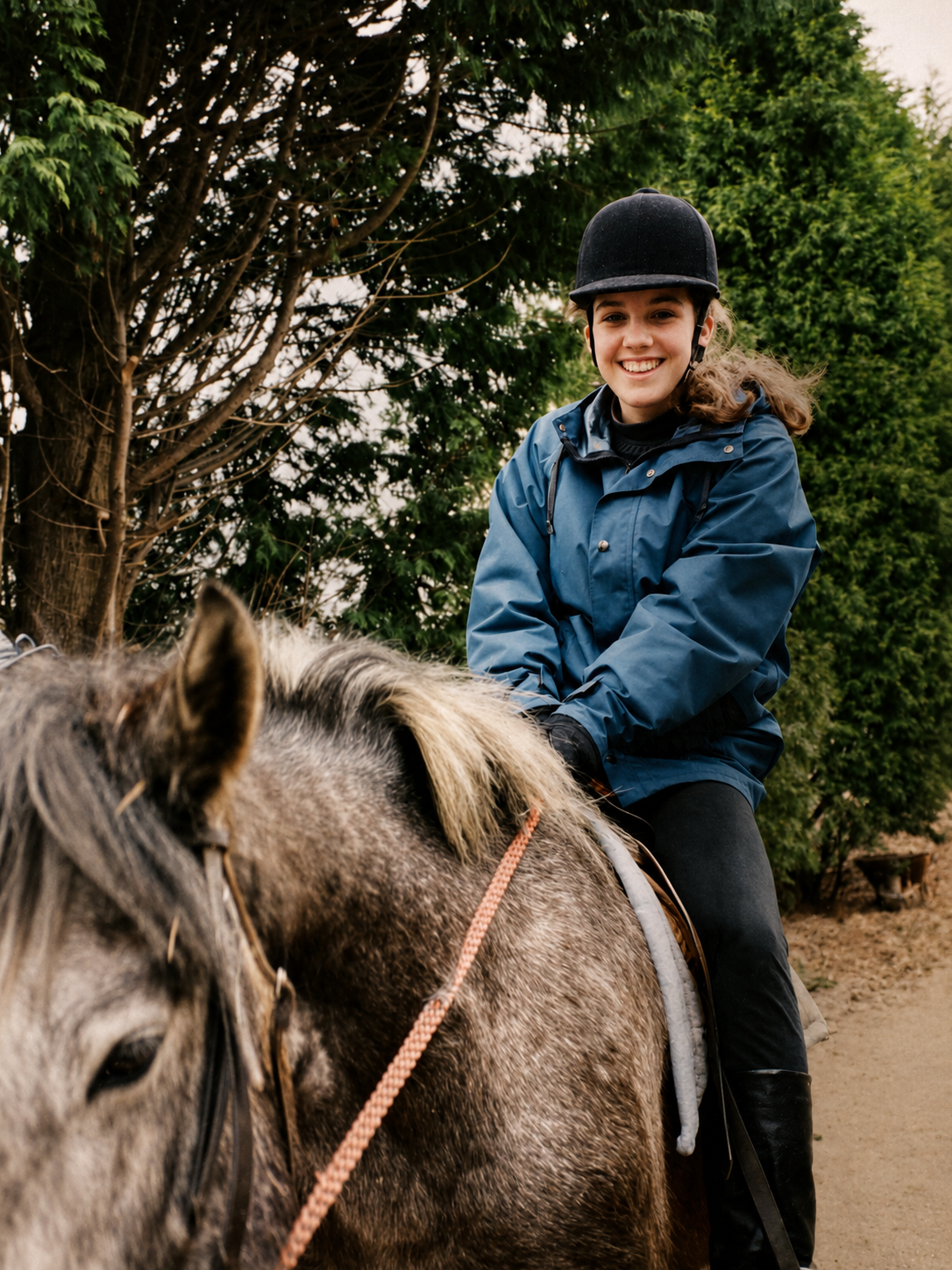
Back outside Bristol the following day, I finally got my wish. Three hours on horseback through the English countryside, in a blue rain jacket against the cold. At some point we rode past a nuclear power station. Not the scenic backdrop you might expect, but somehow completely fitting for a trip that had never been about the expected.

I came back sore in every muscle and spent a good portion of the afternoon lying on a waterbed at Maureen's house. Each muscle had its own opinion about the previous three hours. The waterbed, at least, was forgiving.
The castles had begun to blur together by then, all stone and narrow winding staircases and rooms that echoed. I understand now what I could not appreciate then. But at that age, history had to earn my attention. It rarely did.
That is the difference between traveling and experiencing. Traveling is moving through places. Experiencing is letting them move through you, even when you are fifteen and would rather be on a horse.
In 2018, Sebastien brought his wife and three children to California. My mother and I were there to meet them. We took everyone out for Mexican dinner in El Cerrito, not far from the house where Sebastien had spent those first California summers nearly thirty years before.
The hovercraft is long gone, replaced by the Eurostar. But I carry all of it.
The Channel crossed on a cushion of air. Cheese and bread with a French family in the suburbs of Paris. A horse ridden past a power station in the English countryside.
Not as memory exactly.
As a way of moving through the world.


Comments